


When planning a new metal roof, one of the first questions architects, engineers, contractors, developers and property owners ask is how long the roof sheeting will last.
It sounds like a straightforward question. However, providing a responsible answer requires more than looking at the age, thickness or appearance of the roof sheets.
Consider two buildings fitted with similar-looking metal roof sheeting. One is in a relatively dry inland area. The other is positioned near the coast, where salt, humidity and prevailing winds create a far more corrosive environment.
Even if the roof sheets have the same profile and colour, their long-term performance can differ significantly.
The coating system, roof design, environmental exposure, fasteners, installation quality and maintenance programme all influence how long the roof will remain serviceable.
For this reason, metal roof sheeting should always be assessed as part of a complete roofing system.
WHY METAL ROOF LIFESPAN IS NOT A SINGLE NUMBER
Metal roof sheeting does not have a fixed expiry date.
A quality roof that has been correctly specified, installed and maintained can remain in service for several decades. However, deterioration can occur much sooner when the material is unsuitable for the environment or when the roofing system is poorly designed or installed.
Several factors determine the service life of a metal roof.
THESE INCLUDE:
- The steel substrate and protective coating
- The building’s location and environmental exposure
- The roof profile and Base Metal Thickness
- The roof pitch and drainage capacity
- The fasteners, flashings, sealants and accessories
- Storage, handling and installation practices
- Inspection, cleaning and maintenance
- Product-specific warranty conditions
These factors work together. Improving one component cannot always compensate for an unsuitable product or poorly designed detail elsewhere in the roofing system.
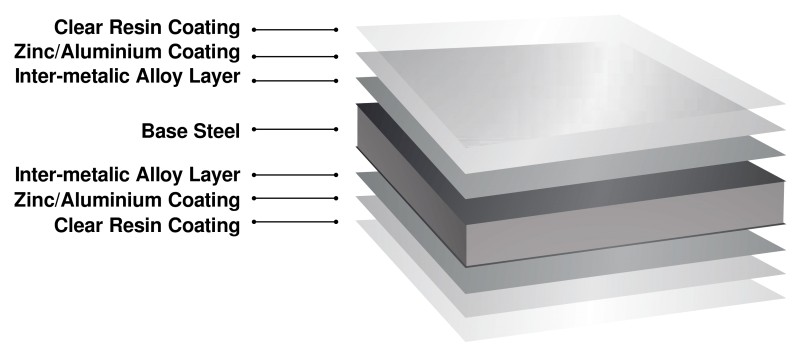
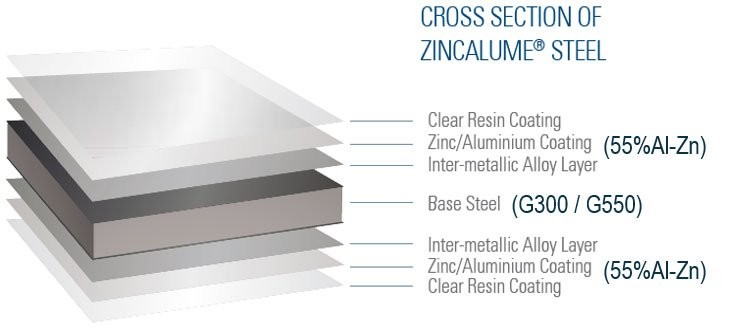
THE COATING SYSTEM MAKES THE DIFFERENCE
The steel core gives metal roof sheeting its strength. The metallic coating protects the steel against corrosion.
Roof sheets can appear similar while offering very different levels of corrosion resistance. The full material specification is therefore more important than colour or appearance alone.
In South Africa, commonly specified coating systems include galvanised steel and aluminium-zinc-coated steel.
Z275 GALVANISED STEEL
Z275 galvanised steel has a total zinc coating mass of 275 grams per square metre.
It can provide practical performance in suitable dry, inland and relatively mild environments. However, galvanised steel generally deteriorates more quickly when exposed to coastal salt, persistent humidity, or aggressive industrial contaminants.
Always confirm the material’s suitability against the building’s location and expected exposure conditions.
AZ150 ALUMINIUM ZINC COATED STEEL
AZ150 products use a coating consisting of approximately 55% aluminium, 43.5% zinc and 1.5% silicon.
The aluminium creates a durable barrier against corrosion. The zinc provides sacrificial protection where the steel is exposed, including around cut edges.
Under comparable conditions, aluminium-zinc coating technology can provide between two and four times the service life of galvanised steel with a similar coating thickness.
AZ150 has a total aluminium zinc coating mass of 150 grams per square metre. It is commonly used for appropriate inland, rural and moderate exposure conditions.
AZ200 ALUMINIUM ZINC COATED STEEL
AZ200 has a higher aluminium-zinc coating mass of 200 grams per square metre.
It provides additional protection for more demanding coastal, industrial and corrosive environments.
Youngman’s premium material options for severe environments include Clean COLORBOND® ULTRA steel and COLORPLUS® Ultima. These products use an AZ200 base with a factory-applied paint system intended for more aggressive exposure conditions.
AZ200 provides more coating protection than AZ150. However, it cannot correct poor drainage, incompatible materials, installation damage or neglected maintenance.
The complete roofing system must still be designed and installed correctly.
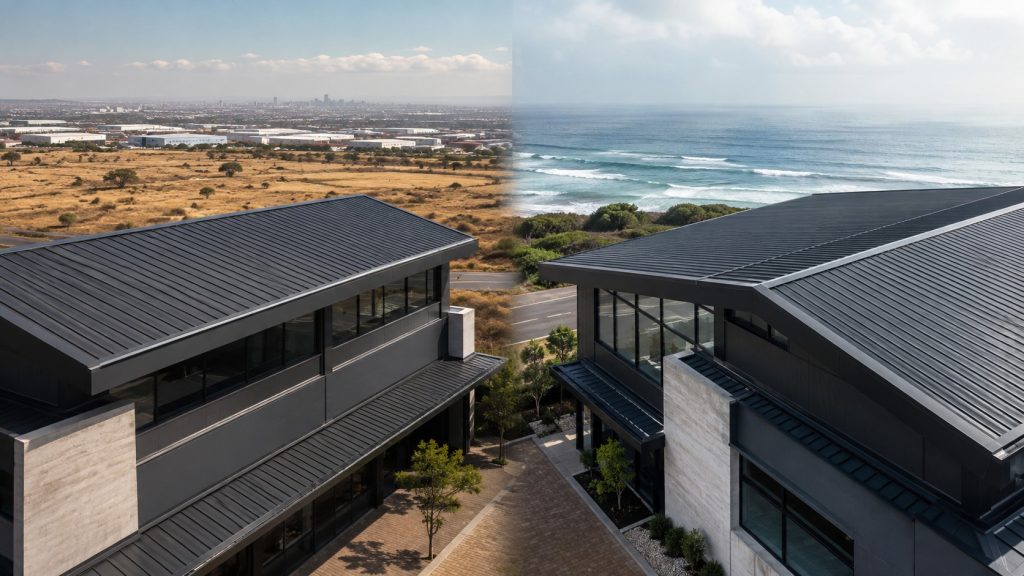
THE ENVIRONMENT CHANGES THE ANSWER
South Africa has widely varied corrosion environments.
A commercial building in Johannesburg will experience different environmental conditions from a coastal development in Cape Town or an industrial facility exposed to airborne pollutants.
Environmental Factors That Can Accelerate Corrosion Include:
- Coastal salt
- Persistent humidity
- Industrial pollution
- Agricultural emissions
- Chemical vapours
- Airborne contaminants
- Condensation
- Areas that are not naturally washed by rain
- Distance from the sea is important, but it should never be the only consideration.
Prevailing winds can carry salt beyond the immediate coastline. Building height, orientation, surrounding structures and local land contours can also influence the amount of salt or contamination deposited on the roof.
Internal exposure must also be assessed.
Swimming pools, food processing facilities, livestock buildings, chemical plants, and high-humidity environments may expose the underside of the roof to conditions more aggressive than the external environment.
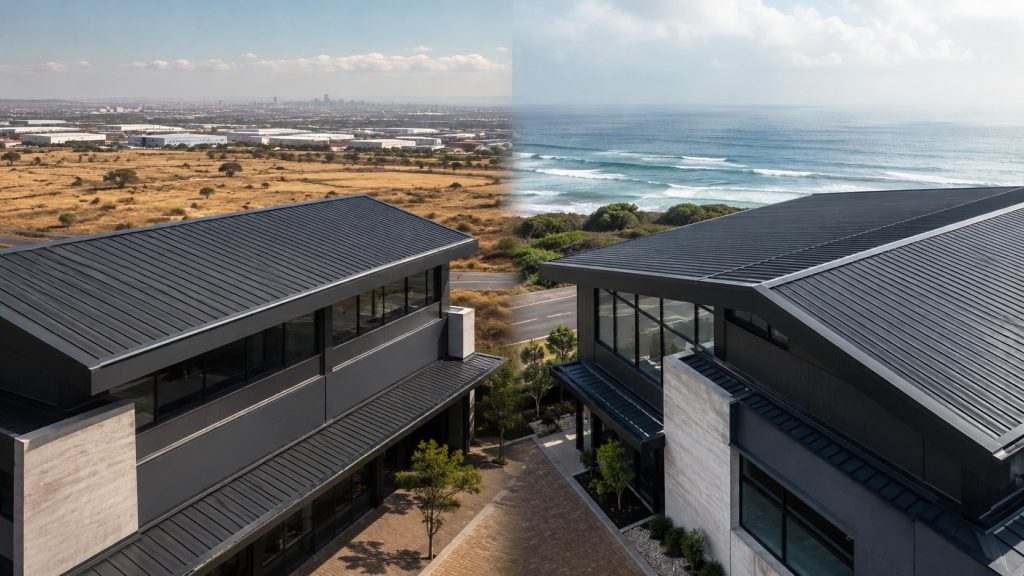
For coastal, industrial, agricultural, or high-humidity projects, obtain technical advice before ordering roof sheeting.
THE ROOF PROFILE AFFECTS LONG-TERM PERFORMANCE
The roof profile does more than shape the building’s appearance. It influences water-carrying capacity, spanning performance, minimum roof pitch, and the fixing method.
Youngman manufactures and supplies a comprehensive range of roof sheeting profiles, including:
- IBR
- Corrugated
- Widek
- Snaplok
- Diamondek
- Springlok 700
The correct profile depends on the roof geometry, purlin spacing, sheet length, expected rainfall, wind loads and architectural requirements.
Water must leave the roof quickly and predictably.
Incorrect pitch, insufficient drainage capacity, blocked gutters, water traps and poorly detailed penetrations can keep moisture in contact with the roof sheeting and accessories.
Over time, this can reduce the service life of an otherwise suitable roofing material.
Concealed fix profiles such as Springlok 700 do not require exposed fastener penetrations through the roof sheet. They also accommodate the natural thermal movement of metal sheeting.
This can be particularly valuable on longer roof runs. However, correct profile selection, purlin spacing, detailing and installation remain essential.
WHY THICKER DOES NOT ALWAYS MEAN LONGER LASTING
Base Metal Thickness affects the roof sheet’s strength, rigidity, spanning ability and resistance to physical damage.
It does not determine corrosion resistance on its own.
Corrosion Performance Is Primarily Influenced By:
- The protective coating
- The coating mass
- The factory-applied paint system
- The environmental exposure
- Installation quality
- Maintenance
A thicker sheet with an unsuitable coating may corrode sooner than a correctly specified thinner sheet with the appropriate protective system.
Thickness, steel grade, profile and coating should therefore be assessed together. Changing one part of the specification without checking the others can affect the roof’s expected performance.
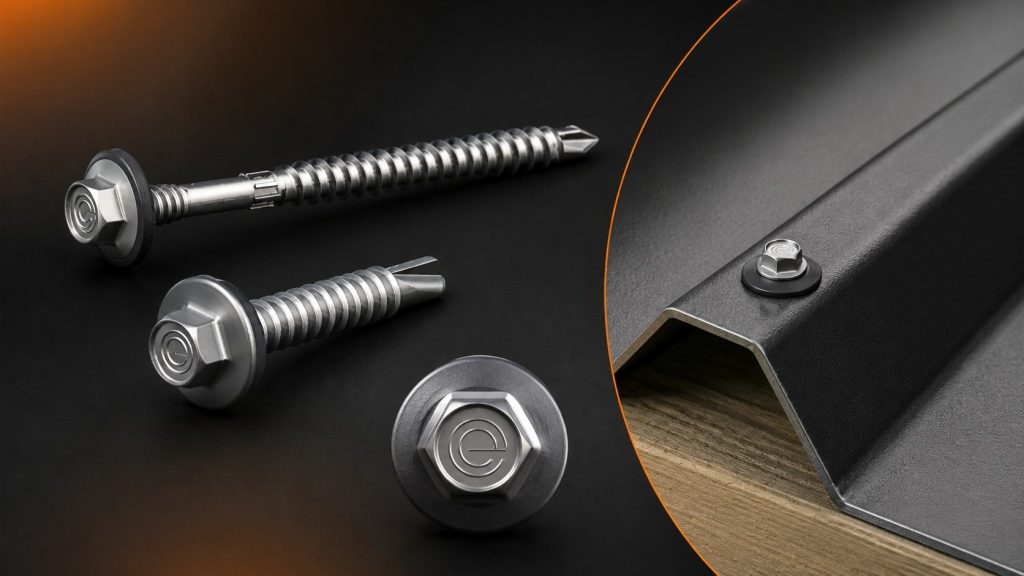
FASTENERS AND ACCESSORIES ARE PART OF THE ROOFING SYSTEM
A metal roof is only as reliable as its connections and details.
Incorrect or inferior fasteners can corrode, loosen or allow water ingress while the roof sheeting remains in good condition.
Youngman supplies Corroshield roofing fasteners in Class 3 and Class 4 options, manufactured in accordance with SANS 1273 requirements.
The Correct Fastener Class Depends On:
- The roof sheeting material
- The supporting structure
- The project location
- The environmental exposure
- The fixing application
- The required service life
More severe coastal or industrial environments will generally require fasteners with a higher level of corrosion resistance.
The fastener must also be installed correctly.
An overtightened fastener can damage the washer or deform the roof sheet. An under-tightened or incorrectly aligned fastener can allow movement and water ingress.
Flashings, ridge cappings, sealants and other accessories must also be compatible with the roof sheeting.
Contact between incompatible metals can create galvanic corrosion. This occurs when dissimilar metals come into contact in the presence of moisture, causing one metal to corrode more rapidly.
Select every component to support the performance of the complete roofing system.
INSTALLATION CAN PROTECT OR SHORTEN ROOF LIFE
Some roofing problems begin before the building is occupied.
Premature deterioration can start during storage, handling, cutting or installation.
COMMON CAUSES INCLUDE:
- Sheets stored where water becomes trapped between them
- Condensation forming between stacked sheets
- Protective coatings scratched during handling
- Abrasive cutting discs damaging the coating
- Metal swarf and drill filings left on the roof
- Fasteners installed too tightly or too loosely
- Incorrect laps, end details or penetrations
- Incompatible flashings, fasteners or sealants
- Insufficient allowance for thermal movement
- Incorrect roof pitch or drainage falls
- Metal swarf is a particular concern.
Small metal particles left on the roof can begin to rust and stain the surface. If they are not removed promptly, they may damage the protective coating beneath them.
Good site practices protect the material from delivery through to handover. The completed roof should also be inspected before practical completion so that any installation defects can be corrected.
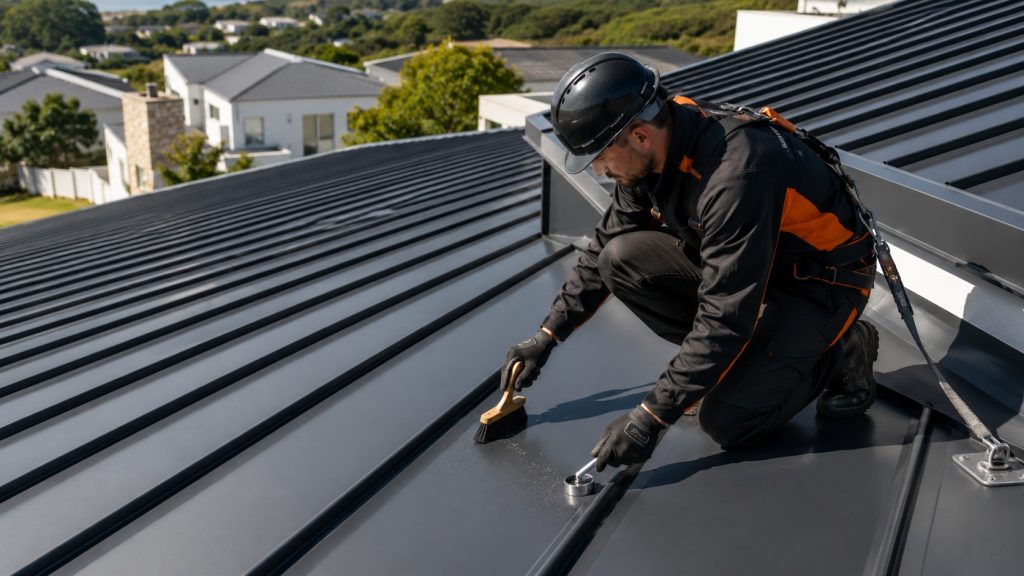
MAINTENANCE PROTECTS THE ORIGINAL INVESTMENT
Metal roofing is low maintenance, but it is not maintenance-free.
A planned inspection programme can identify minor issues before they develop into leaks, localised corrosion or damage to the building below.
As a practical starting point, inspect a metal roof at least once a year. Complete additional inspections after severe storms, roof access, or work carried out by other contractors.
A ROOF INSPECTION SHOULD INCLUDE:
- Loose, damaged or missing fasteners
- Deteriorated sealing washers and sealants
- Scratches or damage to the protective coating
- Early signs of corrosion
- Rust staining around fasteners or cut edges
- Blocked gutters, valleys and outlets
- Leaves, debris and standing water
- Loose flashings and cappings
- Damage around skylights and roof penetrations
- Changes around solar panel installations
Areas that are not naturally washed by rain require particular attention.
These include the underside of exposed eaves, sheltered cladding and surfaces beneath overhangs. These areas should generally be rinsed with fresh water approximately every six months.
More frequent cleaning may be required in severe coastal or industrial environments.
Always follow the maintenance requirements attached to the selected product and warranty.
SO, HOW LONG DOES METAL ROOF SHEETING LAST?
Published industry information for modern 55% aluminium zinc coated steel refers to service life expectations of approximately 20 to 60 years.
This is a broad service life range. It is not a universal warranty or a guaranteed replacement date.
A correctly specified, installed and maintained roof may remain serviceable for several decades. In suitable conditions, quality aluminium zinc coated steel can perform for 50 years or longer.
However, premature deterioration can occur when:
- The coating is unsuitable for the environment
- Water is allowed to collect on the roof
- Fasteners or accessories are incompatible
- Installation damages the protective coating
- Metal swarf is left on the roof
- Early corrosion is not addressed
- Maintenance requirements are ignored
The lifespan range only becomes meaningful once the product, design, environment and maintenance conditions are known.
WARRANTY AND SERVICE LIFE ARE NOT THE SAME
A material warranty should not be confused with the roof’s expected lifespan.
A warranty is a defined commitment that applies under specific terms and conditions. Service life is the period during which the roof may continue to perform its intended function with appropriate maintenance.
Warranty Duration and Eligibility May Depend On:
- The selected product
- The coating class
- Distance from the coast
- The building’s use
- Roof pitch and drainage
- Installation methods
- Compatible fasteners and accessories
- Inspection and maintenance records
Never assume that a warranty automatically applies because a product name appears on a quotation.
Confirm the exact material, coating class, and warranty eligibility before ordering. Retain product certificates, delivery records, installation reports, and maintenance records.
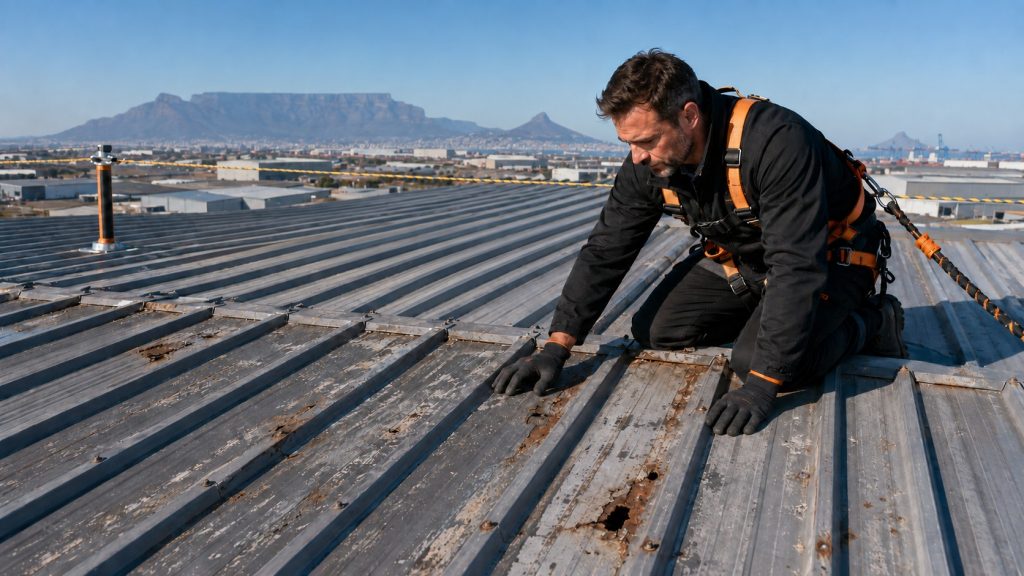
WHEN SHOULD A METAL ROOF BE REPAIRED OR REPLACED?
The roof’s age alone is not enough to make this decision.
A Professional Roof Condition Assessment Should Consider:
- The extent and location of corrosion
- The condition of the protective coating
- Fastener and washer performance
- Water tightness
- Sheet deformation
- Drainage
- Structural support
- The feasibility of local repairs
Isolated coating damage, deteriorated washers, loose flashings or a limited number of corroded fasteners may be repairable.
Widespread perforation, recurring leaks, severe corrosion at laps or fasteners, extensive distortion or failure to meet the building’s performance requirements may justify partial or complete replacement.
Repairs must use compatible materials. An unsuitable patch or fastener can trap water or introduce galvanic corrosion, making the original problem worse.
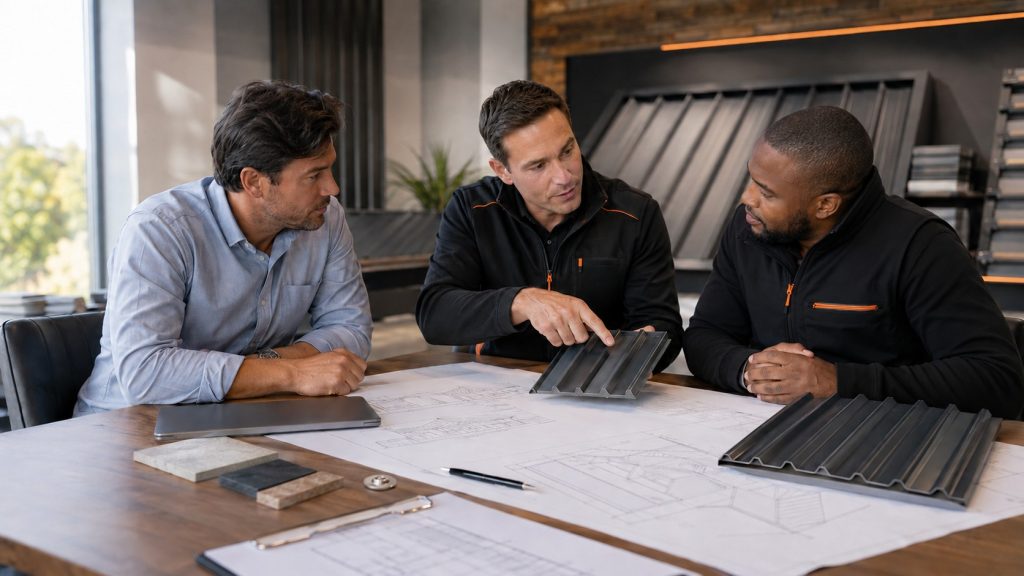
QUESTIONS WE FREQUENTLY RECEIVE
CAN METAL ROOF SHEETING LAST 50 YEARS?
Yes. Correctly specified, installed, and maintained aluminium zinc-coated roof sheeting can remain serviceable for 50 years or longer in suitable conditions.
This should be treated as a possible service life, not as a standard warranty that applies to every roof.
IS AZ200 ALWAYS BETTER THAN AZ150?
AZ200 has a higher aluminium zinc coating mass and provides additional corrosion protection.
It is commonly selected for more aggressive coastal, industrial and corrosive environments. The correct choice still depends on the project location, roof design, factory applied paint system and warranty requirements.
DOES THICKER METAL ROOF SHEETING LAST LONGER?
Not necessarily.
Greater Base Metal Thickness improves structural strength and resistance to physical damage. Corrosion life depends mainly on the protective coating, environment, detailing, installation and maintenance.
HOW OFTEN SHOULD METAL ROOF SHEETING BE INSPECTED?
An annual inspection is a sensible minimum.
Complete additional inspections after severe storms, roof access, or work by other contractors. High-risk coastal, industrial or process environments may require more frequent inspections.
HOW OFTEN SHOULD A METAL ROOF BE CLEANED?
Rain normally cleans exposed roof surfaces.
Areas not reached by rain should generally be rinsed with fresh water about every six months. Severe coastal and industrial environments may require more frequent cleaning.
IS CONCEALED FIX ROOF SHEETING MORE DURABLE?
Concealed fix systems remove exposed fastener penetrations through the roof sheet and accommodate thermal movement.
This can reduce certain risks, particularly on long roof runs. Their performance still depends on correct profile selection, clip spacing, detailing and installation.
WHAT ARE THE FIRST SIGNS THAT A METAL ROOF NEEDS ATTENTION?
Early warning signs include rust staining, coating damage, loose fasteners, deteriorated washers, blocked drainage, water marks below the roof and localised corrosion around cut edges, laps or penetrations.
Early inspection normally gives the building owner more repair options and can help prevent more extensive damage.
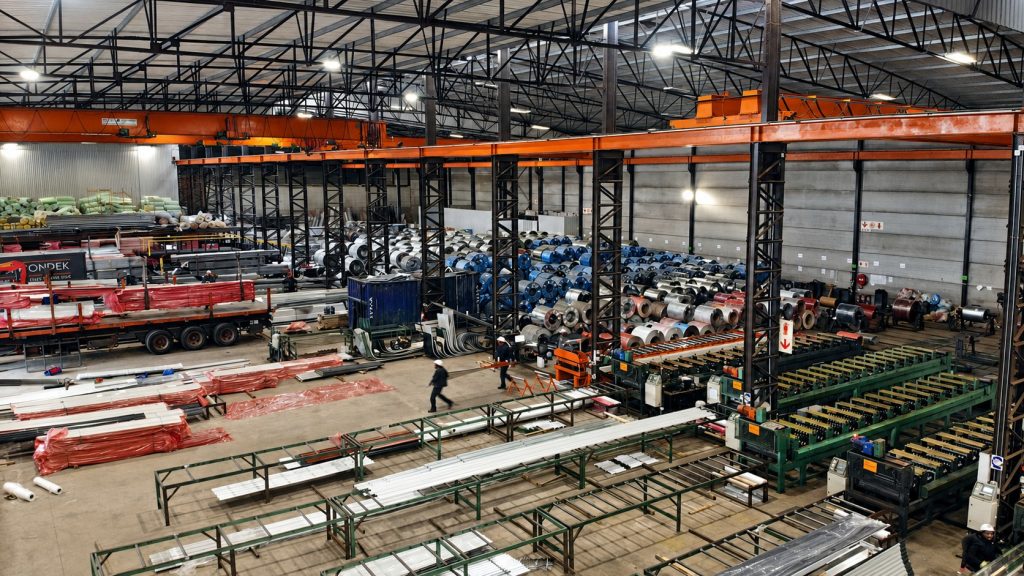
BUILDING CONFIDENCE THROUGH TECHNICAL EXPERTISE
A metal roof represents a significant investment. Specification decisions made during the design stage can influence how that roof performs for decades.
The best results are achieved when the environment, material, coating mass, profile, Base Metal Thickness, fasteners, accessories, installation and maintenance requirements are considered together.
At Youngman Roofing & Insulation, we work alongside architects, engineers, quantity surveyors, contractors, developers and property owners to help identify roofing systems suited to each project’s location and performance requirements.
By combining technical knowledge, quality products and practical guidance, Youngman helps project teams reduce specification risk, avoid preventable maintenance costs and support dependable roof performance throughout the building’s service life.
TECHNICAL ROOFING SUPPORT FROM YOUNGMAN ROOFING & INSULATION
Youngman Roofing & Insulation Provides Technical Support Throughout The Roofing Specification Process, Assisting With:
- Site and environmental exposure assessments
- Roof profile selection
- Material and coating selection
- Base Metal Thickness requirements
- Roof pitch and drainage considerations
- Fastener and accessory compatibility
- Roofing and insulation system selection
- Warranty and maintenance guidance
- Technical documentation and product information
Whether you are designing a new roofing system, planning a roof replacement, or reviewing an existing specification, our technical team can help identify an appropriate solution for your project.
ABOUT YOUNGMAN ROOFING & INSULATION
For more than 35 years, Youngman Roofing & Insulation has supplied metal roofing systems, concealed fix roofing solutions, insulation and roofing accessories across South Africa.
Supporting commercial, industrial, retail, and residential projects, Youngman works alongside architects, engineers, quantity surveyors, contractors, and project teams, providing technical expertise and practical guidance throughout the design, specification, and construction process.
With established manufacturing capabilities and a strong focus on quality, service and long-term performance, Youngman helps customers select roofing and insulation solutions suited to the specific requirements of each project.
Access technical resources, datasheets, and roofing guidance here:
www.youngman.co.za/resource-hub/
For project support and specification assistance: Contact Us